

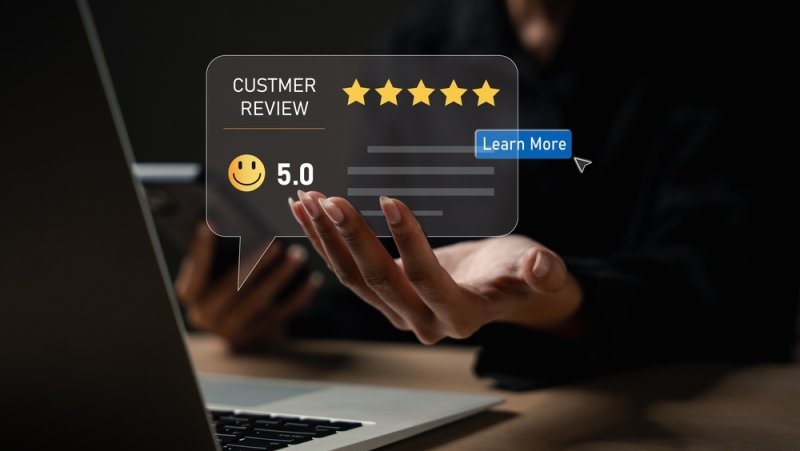
Customer ratings are ratings people give you after having an interaction with the business, making a purchase, or using a service. Ratings are usually on a 1-5 scale, but other scales include percentages, points, etc.
It's a measure of the customer's experience. Your experience might be the products, service, value, delivery, communication, or reliability. Or it might be something totally different. The same score means different things on different sites.
The more that you compare, the more helpful a rating is. If a lot of customers tell you the same thing, that tends to matter more than a fluke one-star or five-star review.
For instance, a company could boast a high number of five-star ratings but have a few recent reviews that talk about delayed delivery. That doesn't necessarily mean the company is delivering bad service, but it can give potential buyers something to look into.
Five-star ratings simplify comparison. A one-star rating indicates an abysmal experience, and five stars would suggest an overwhelmingly positive one. Ratings in between can suggest either an experience that was good, but not memorable, or one that had some hits and some misses.
But a 5-star rating alone doesn't tell you everything. A business that has thousands of reviews but doesn't have a perfect score may actually say more to a customer than a business that has just a few reviews and a perfect score.
When evaluating a rating, consider:
Headlines are great for quick headlines, but this simple method provides more context. For other reasons, recent feedback is vital when a business has altered its products, staff, policies, or service procedures.
A customer rating system provides a method for companies to receive feedback. Customers can choose a rating, respond to questionnaires, leave comments, or rate different aspects of their experience.
Where the actual worth lies is in how you use this data once it has been gathered. If customers consistently rate your product poorly after one step of the customer journey, then you can look into exactly what is wrong. It is, therefore, a helpful indicator of how well you are performing.
Organizations can analyze comments for insights along these lines:
This set of charts and patterns can help teams decide what to improve. A rating only informs a business that customers are unhappy, but the comments can provide reasons.
A score is a reflection of how customers on a specific platform experienced a business in a specific period. Businesses are rated only if customers leave reviews.
The overall rating of a business can also be affected if more customers leave a review. For a small number of reviews, an additional negative rating could significantly impact the overall score of the business, and for a large number of ratings, that same score would have a smaller mathematical impact.
The common method for calculating an average customer rating is to add all the customer ratings and divide by the total number of ratings. E.g., 5+4+5+3+4/5 = 4.2 Average Customer Rating.
This number fluctuates when a new rating is added, so don't make the mistake of assuming a short-term fluctuation means a trend in the long term. Looking at an average customer rating over time can give you a clearer idea of whether your client's customers are getting happier or less happy.
A rating system for businesses is a good method when clients have the means to express their opinions with utmost ease and sincerity. Feedback is asked by companies after a purchase has been made or a service has been consumed, without any pressure to deliver a good score.
Be honest: Use honest reviews for something constructive, and avoid attempts to game the rating. Negative reviews can point out issues businesses might not see, for example, when a handful of customers have similar complaints.
In some cases, a low score does not necessarily warrant defensive action. Companies may simply be able to recognize the problem, assess what they are doing, and provide a response.
This method might be informative for upcoming clients also. A company doesn't require all the customers to report a flawless experience to prove quality. Regular service, truthful feedback, as well as attempts to deal with legitimate issues will paint a broader picture.
The first step to improving customer ratings is to improve the experience behind them. Businesses should try to address the problems customers list over and over rather than trying to get more good reviews.
Product info, delivery, and at least some level of support, communication, accurate expectations, and affordability can all affect how the customer perceives an experience. Once those are addressed, it's time to make it easy for a real customer to tell everyone about it.
Customer reviews enable customers to make an instant comparison between businesses, but the score should never be the be-all and end-all. A five-star rating, in conjunction with review volume, recency, and content, can provide a wider perspective of the experience.
A customer ratings system for businesses can enable customer feedback to be translated into actionable insights. Tracking the average customer rating, noting trends in customer complaints, and fixing service issues can help identify areas for improvement. When the business ratings system is administered fairly, it can be a win for both customers and businesses.
We can't say that any particular number guarantees that a customer score is valid in all cases. More, without question, is better, but also check that the ratings aren't too old and don't reveal a pattern of consistency in written reviews.
Different companies may get feedback from different customers and get ratings in various ways. One site could poll for the overall business while another could poll for a specific service or transaction.
Newer scores may give a more accurate picture of the current customer experience if the company has made changes to its offerings, policies, people, or processes. Older reviews may be more accurate for historical context but less relevant.
Read both positive and negative reviews for common themes. Look for specifics, not just emotional language. Consistently seeing the same negative comments from customers about a product can be more helpful than the average review score.
Yes. Moving out of traditional open-ended reviews by working on the customer experience can help you move to positive feedback organically. Products, communication, delivery, support, fixing common complaints - then focus on your real customers and their feedback.
This content was created by AI